Real brands. Real numbers.
Profit on purpose.

Three accounts, three different problems — a profit transformation, a climb to position one, and a launch from absolute zero. The thread that connects them is a system, never luck. Here's exactly how each one happened.

Browse the Work

Pick a story to dive into

Each one is a different problem solved with the same system. Filter by what you're facing, then read the full story below.

No case studies in this category yet — more coming soon.
01
Case Study 01 · Catalog & Profit Transformation

From revenue obsession to profit-first growth

A brand generating sales but bleeding profit. We found which 8 of 47 SKUs deserved to win, cut the rest, and rebuilt the system — turning a net loss into a 23.8% margin in under five months.

+572%
Profit growth · Dec → May
23.8%
Margin · from −4.3%
+$17.7K
Extra profit · less revenue
01
The Situation

A brand generating revenue — but bleeding profit

On the surface the numbers looked fine: sales, traffic, listings that ranked. Underneath, the account was structurally broken. Nothing was connected to anything else, or to a clear commercial outcome.

01

No catalog strategy

47 active SKUs, but no answer to which products deserved investment. Weak products ran full budgets while strong ones went out of stock.

02

PPC without a purpose

Spend was running but building nothing — no keyword intent structure, no ranking ladder. PPC was pure cost.

03

Listings that didn't convert

Pages weren't built around how customers actually search and decide. Every unconverted visit was a wasted ad dollar.

04

Indexation on assumptions

SEO anchored to internally-invented keywords. Real demand pools were missing — the algorithm didn't understand the products.

02
Our Approach

A system, not a tactic

Most agencies start with ads. We started with one question: which products in this catalog have a right to win? Every decision that followed — budget, content, keywords, inventory — was anchored to that answer.

1

Full catalog & market-fit analysis

Audited all 47 SKUs across 10 commercial dimensions. Result: only 8 deserved focused scaling.

2

Controlled liquidation

For products that didn't make the cut, a controlled sell-through recovered cash and freed storage.

3

Conversion rebuild

SEO grounded in real keyword pools; images and A+ content rebuilt around the customer's decision journey.

4

Intent-based PPC

Every keyword pool got a role: spend builds indexation → cuts paid dependency → grows rank → improves margin.

03
The Results

What the Sellerboard data actually shows

By May, revenue was lower than November — and that is the point. In January the brand made $96,578 in revenue but kept only $3,728. By May, revenue fell to $61,311 — but profit reached $14,590. Less revenue, nearly 4× the profit.

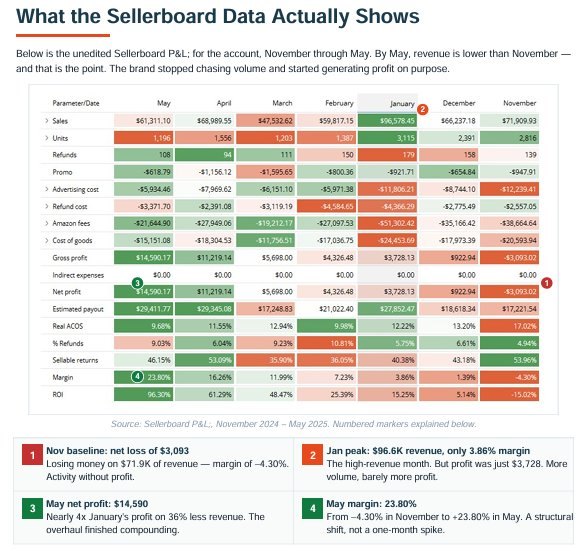
Exhibit A · Profit Margin Progression
Profit margin progression · −4.3% in November to +23.8% in May. A structural shift, not a one-month spike.
Exhibit B · Unedited Sellerboard P&L
The full Sellerboard P&L, November → May. Red cells are losses, green cells are profit — the account turning green month over month.
04
The Takeaway

The real problem was never revenue

The brand didn't need more sales. It needed to know which products deserved to exist — and which ones were quietly draining it.
Next case study
Engineering the climb to position one
Read case 02
02
Case Study 02 · Keyword Rank & Organic Growth

Engineering the climb to position one

Instead of fighting the algorithm with brute-force spend, we made the product the best answer for a pool of high-intent keywords — and let the algorithm reward it with rank.

#1
On target keywords · from rank 14
4.1×
Better sales rank · 45K → 11K
+58%
Conversion rate · 4.6% → 7.3%
01
The Thesis

We don't fight the algorithm. We feed it.

The product entered a market with strong, proven demand. Most sellers try to muscle up the rankings with brute-force spend. We took the opposite view: Amazon's algorithm has one job — surface the product that best satisfies each search. So we set out to provably become the best answer for a pool of high-intent keywords.

Conversion rate, higher

The clearest signal that buyers prefer your answer for the search.

Return rate, lower

Proof the product delivers on the promise, protecting rank.

Reviews, reinforcing

Social proof that compounds trust and conversion over time.

Inventory, in stock

Steady stock keeps the ranking momentum from ever resetting.

02
The Strategy

Earn the right to rank — by being the best answer

Before touching a single campaign, we made sure the product genuinely deserved to win its keywords: finding a position where our offer was objectively better, validating it with data, and engineering the listing to convert that exact customer.

1

Positioning

Studied incumbents to find the gaps — the unique positions our product could own.

2

Keyword pool

Mapped keywords tied to those intents — searches where our advantage actually matters.

3

SQP validation

Confirmed via Search Query Performance that those keywords converted better for us than the market.

4

Listing

Title, bullets, images and A+ built for that position — high CVR, low returns.

03
The Ranking Engine

Campaigns that reinforce — never compete

With the listing built to convert, advertising's job was visibility and rank — without the self-inflicted wounds that quietly cap most accounts. The principle: protect the campaign history the algorithm learns from, and make every campaign reinforce the others.

One exact target per campaign

Clean data, clean history, zero internal competition.

Broad for root coverage

Catches long-standing variants and newly emerging search terms.

Placement by deservingness

Top-of-Search to keywords that earned it; Rest-of-Search to the rest.

Protect the history

No two campaigns ever fight for the same position or muddy each other's signal.

04
The Proof

From buried to position one

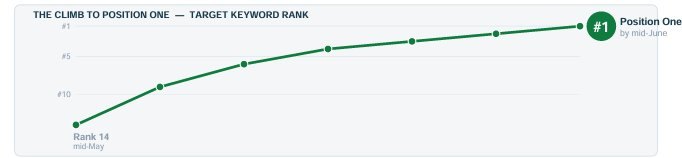
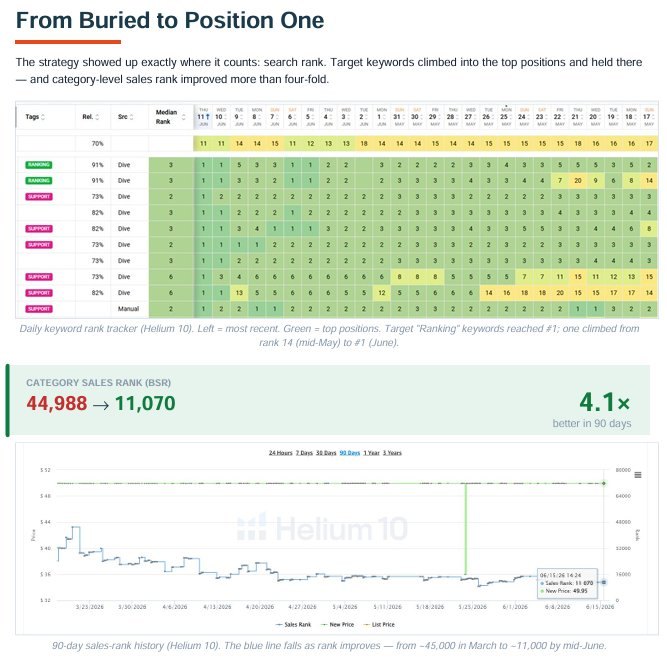
The strategy showed up where it counts: search rank. Target keywords climbed into the top positions and held there — one from rank 14 to #1 — while category sales rank improved more than four-fold.

Exhibit A · Target Keyword Rank
The climb to position one — target keyword from rank 14 (mid-May) to #1 (mid-June).
Exhibit B · Rank Tracker & Category BSR
Daily rank tracker (Helium 10) with
Daily rank tracker (Helium 10) with "Ranking" keywords reaching #1, and the 90-day category sales rank falling from ~45,000 to ~11,070.
Next case study
A profitable launch, from the first week
Read case 03
03
Case Study 03 · Pet Supplies · Product Launch

A profitable launch, from the first week

Zero reviews, a lean budget, and a category dominated by thousands-of-review rivals. We validated product-market fit first, then scaled — profitable from week one.

$47.7K
Total sales · first 60 days
28.6%
Net margin
7.01%
TACoS · lean ad dependency
01
The Challenge

Launching into a crowded category — from nothing

Most launches lean on a crutch: early reviews, an external traffic push, or aggressive discounting. This launch had none. The product entered Pet Supplies — one of Amazon's most competitive categories — as a complete unknown. The mandate: prove product-market fit and profitability before spending aggressively.

01

Zero social proof

No reviews, no ratings, no recognition. Every visitor had to be convinced by the listing alone.

02

Entrenched competition

A category dominated by sellers with thousands of reviews and years of history.

03

Lean budget

No war chest. The launch had to work on a controlled budget — profitability couldn't be deferred.

04

Prove it first

Confirm the product converted and ranked organically before pouring in budget.

02
The Strategy

Validate first. Then scale — profitably.

The launch followed a deliberate sequence: build a listing that earns the sale on its own merits, confirm the market is responding before committing budget, then deploy a structured PPC engine tuned daily on real data.

1

Listing foundation

A page for the algorithm and the human buyer — sharp value props, backend terms for long-tail intent.

2

Validate before scaling

Held back aggressive spend until buyers converted without social proof.

3

Full-funnel PPC

Segmented exact / phrase / broad, ASIN targeting, controlled auto with search-term harvesting.

4

Daily optimization

Monitored ACoS, TACoS, CTR and CVR every day — shifting budget to winners, pausing dead targets.

03
The Results

Profitable every single week — from a standing start

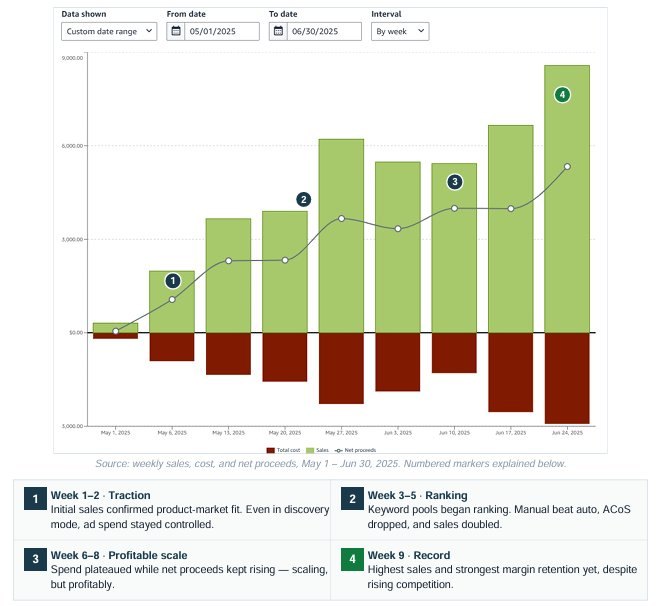
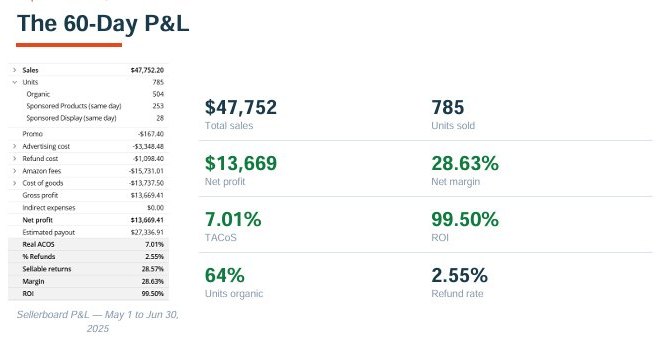
From May 1 to June 30, sales grew consistently with positive net proceeds every week, despite starting with zero reviews. $3,348 in ad spend produced $47.7K in sales — and 64% of units sold organically, hard proof of product-market fit.

Exhibit A · Weekly Sales, Cost & Net Proceeds
Weekly sales, cost and net proceeds, May 1 – Jun 30. Positive net proceeds every single week as the launch scaled.
64%
Units sold organically (504)
36%
Units from ads (281)
99.5%
ROI on ad spend
Exhibit B · The 60-Day P&L
The full 60-day Sellerboard P&L — $13,669 net profit at a 28.63% margin, with 64% of units sold organically.
04
The Takeaway

A repeatable launch model

It wasn't more spend. It was smarter spend — buyer psychology, disciplined PPC, and the patience to validate before scaling.
Like what you see?
Get this kind of work on your account
Request a free audit
Ready when you are

Let's find the profit hiding in your account

No cost, no obligation. We'll show you exactly what your catalog, PPC structure, SEO indexation and conversion look like — delivered in 7 days.

Book a Meeting Request Free Audit